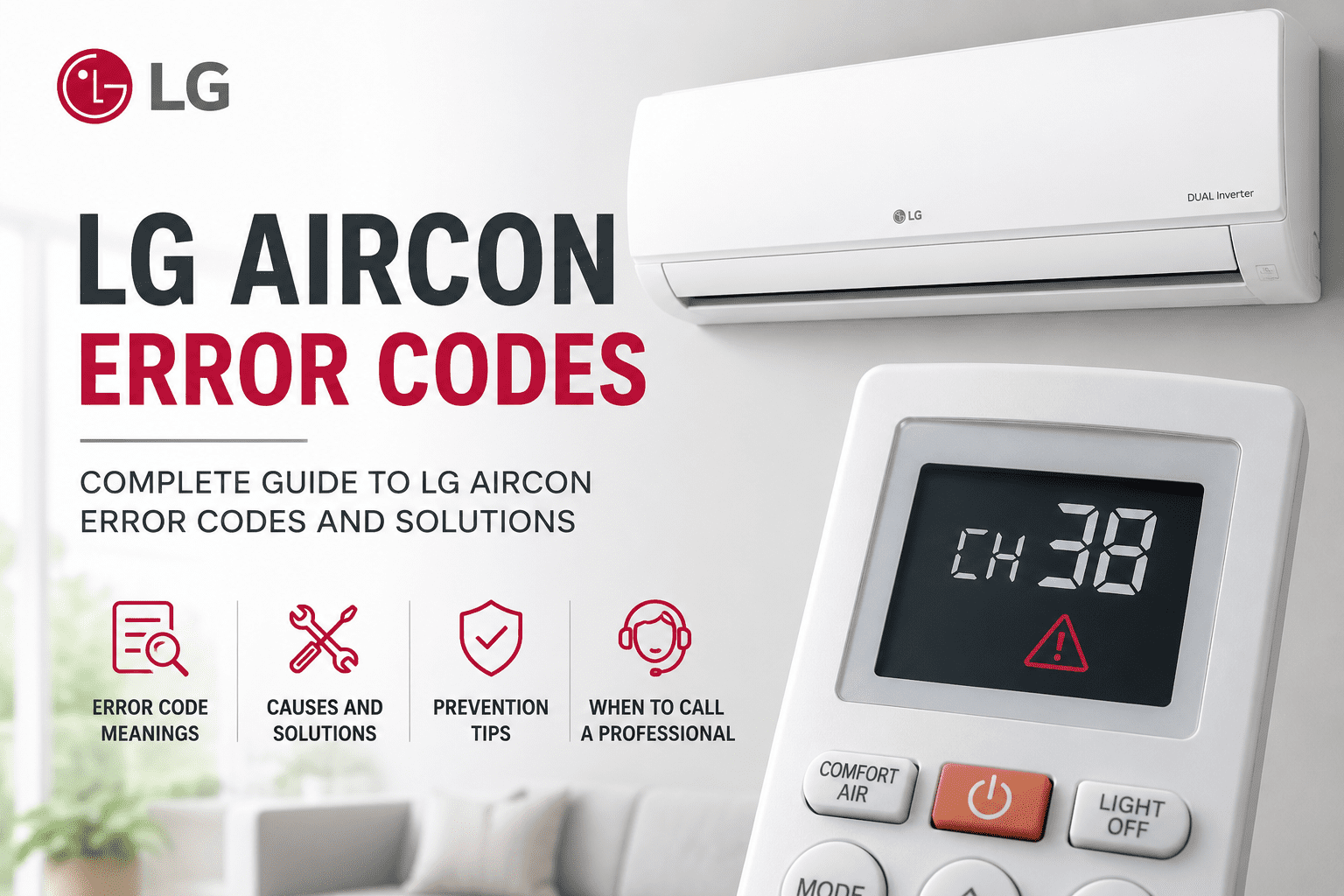
Your LG aircon is flashing LEDs on the indoor unit, or displaying a numeric error code on the remote, and you need to know what it means. You need three things: how to read the LED blink pattern on your LG unit, what each code actually represents, and whether you can fix it yourself or need to call a technician.
This guide answers all three. At Lion City Aircon, we’ve serviced over 25,000 aircon units across Singapore since 2016, including thousands of LG splits. This page is based on LG’s official technical documentation cross-checked against what we actually see in real Singapore homes.
Jump to your section:
- How to Read Your LG Error Code
- Quick Reference Table
- Detailed Error Code Sections
- Repair Cost in Singapore
- Frequently Asked Questions
How to Read Your LG Error Code
LG aircons display error codes through a combination of LED blink patterns on the indoor unit and (on some models) numeric codes on the remote controller or wall display. Understanding the LED system is essential because most Singapore homes have LG residential splits with two indicator LEDs and no built-in display.
Reading the Indoor Unit LEDs
The standard LG residential indoor unit has two LEDs on the display panel:
- LED1 (Heating LED): Used as the primary error indicator. Counts the tens digit of the error code.
- LED2 (Cooling LED): Used as the secondary indicator. Counts the ones digit of the error code.
The LEDs flash in a specific pattern that maps directly to the error code:
- When a fault is active, watch both LEDs for at least 30 seconds.
- Count how many times LED1 blinks before it pauses. That’s the first number.
- Count how many times LED2 blinks after that. That’s the second number.
- Combine them. For example, LED1 blinks 6 times, LED2 blinks 1 time, equals Error Code 61 (condenser coil temperature too high).
- If LED2 doesn’t blink at all (shown as “none” in our tables), only LED1 matters. For example, LED1 blinks 5 times, LED2 doesn’t blink, equals Error Code 5 (indoor-outdoor communication failure).
Reading the Outdoor Unit PCB LEDs
For codes related to the outdoor unit (codes 21 onwards), you can also check the PCB LEDs inside the outdoor unit’s control box. Only do this if you’re comfortable opening the unit; otherwise leave it for a technician.
- Switch off the outdoor unit at the isolator switch.
- Remove the top cover of the outdoor unit (typically 4 to 6 screws).
- Remove the lid covering the PCB control box.
- You’ll see two LEDs: LED1 (Green) and LED2 (Red).
- Switch the power back on and observe the blink pattern.
- The PCB LEDs follow the same counting logic as the indoor LEDs.
If You Can’t Read the LED Pattern
- Record a 30-second video of the LED pattern with your phone. Send to us via WhatsApp.
- We can identify the code from the video pattern alone.
- WhatsApp +65 8818 5781.
How to Read an LG Error Code
LG codes are numeric and grouped by fault category:
- Codes 1-12: Indoor unit faults (thermistors, communication, fan motor, EEPROM)
- Codes 21-32: Inverter and compressor electrical faults (DC voltage, IPM, current)
- Codes 40-48: Outdoor thermistors and sensors
- Codes 53: Outdoor-to-indoor communication
- Codes 60-67: Outdoor PCB, temperature protection, fan motor
The further into the 20s and 60s the code is, the more likely it involves the inverter or compressor none which means more expensive parts and more urgent diagnosis.
Quick Reference Table: LG Error Codes
| Code | What it Means | LED1 Blinks | LED2 Blinks | Severity |
|---|---|---|---|---|
| 1 | Indoor return air thermistor fault | 1× | none | Medium |
| 2 | Indoor inlet pipe thermistor fault | 2× | none | Medium |
| 5 | Indoor to outdoor communication failure | 5× | none | High |
| 6 | Indoor outlet pipe thermistor fault | 6× | none | Medium |
| 9 | Indoor unit EEPROM error | 9× | none | High |
| 10 | Indoor fan motor lock | none | 1× | High |
| 12 | Indoor middle pipe thermistor fault | 2× | 1× | Medium |
| 21 | DC peak error / IPM fault | 2× | 1× | High |
| 22 | CT2 error / AC input current too high | 2× | 2× | High |
| 23 | DC link voltage too low | 2× | 3× | High |
| 25 | Voltage too low or too high | 2× | 5× | High |
| 26 | Inverter compressor seized / not rotating | 2× | 6× | High |
| 27 | PSC fault / inverter current too high | 2× | 7× | High |
| 28 | Inverter compressor DC voltage too high | 2× | 8× | High |
| 29 | Inverter compressor amperage too high | 2× | 9× | High |
| 31 | CT thermistor current too low | 3× | 1× | Medium |
| 32 | Compressor discharge pipe temperature too high | 3× | 2× | High |
| 40 | CT thermistor disconnected or shorted | 4× | none | Medium |
| 41 | Compressor discharge pipe thermistor fault | 4× | 1× | Medium |
| 44 | Outdoor inlet air thermistor fault | 4× | 4× | Medium |
| 45 | Outdoor condenser coil middle thermistor fault | 4× | 5× | Medium |
| 46 | Outdoor suction line thermistor fault | 4× | 6× | Medium |
| 48 | Outdoor coil outlet (liquid line) thermistor fault | 4× | 8× | Medium |
| 53 | Outdoor to indoor communication failure | 5× | 3× | High |
| 60 | Outdoor PCB EEPROM check sum error | 6× | none | High |
| 61 | Outdoor condenser coil temperature too high | 6× | 1× | High |
| 62 | Inverter compressor PCB heat sink too high | 6× | 2× | High |
| 63 | Condenser coil pipe thermistor temperature too low | 6× | 3× | Medium |
| 65 | Heat sink thermistor disconnected or shorted | 6× | 5× | Medium |
| 67 | Outdoor BLDC fan motor lock | 6× | 7× | High |
Indoor Unit Faults (Codes 1-12)
Code 1: Indoor Return Air Thermistor Fault
The thermistor reading return air temperature at the indoor unit has disconnected or shorted. Common causes: loose sensor connector, defective thermistor, or damaged wire. The unit may still run but won’t accurately modulate cooling based on room temperature. Cheap fix (parts under $87.20, repair from $141.70).
Code 2: Indoor Inlet Pipe Thermistor Fault
The thermistor on the inlet pipe of the indoor heat exchanger is faulty. Same fix pattern as Code 1. Important sensor because it’s used for freeze protection logic.
Code 5: Indoor to Outdoor Communication Failure
One of the most common LG codes we attend in Singapore. The indoor unit can’t talk to the outdoor unit. First check: is the outdoor unit isolator switched on? Trip the breaker at the DB box. Other causes: damaged communication cable, loose terminal connection, or failed PCB on either end. We often resolve Code 5 by simply re-tightening a loose terminal screw.
Code 6: Indoor Outlet Pipe Thermistor Fault
The thermistor on the outlet pipe of the indoor heat exchanger is faulty. Same fix pattern as Code 1.
Code 9: Indoor Unit EEPROM Error
The EEPROM chip storing the indoor unit’s configuration has data corruption. Causes: failed EEPROM component, faulty PCB sampling circuit, or the chip was inserted wrong during a previous service. The unit can’t operate normally until the EEPROM is reset or replaced. Sometimes a power reset clears it temporarily.
Code 10: Indoor Fan Motor Lock
The indoor fan motor has stopped rotating or its rotation has been blocked. Causes: failed motor bearings, foreign object in the fan wheel, broken motor wiring, or failed indoor PCB. We sometimes find dust accumulation so heavy that the fan can’t spin freely. A proper service usually clears this; if not, fan motor replacement is needed ($218 to $381.50).
Code 12: Indoor Middle Pipe Thermistor Fault
The middle pipe thermistor on the indoor heat exchanger is faulty. Same fix pattern as other thermistor codes.
Inverter and Compressor Electrical Faults (Codes 21-32)
Codes in the 20s and 30s all relate to the inverter drive and compressor. These are serious. Don’t keep running the unit if you see any of these codes. Many involve high voltage or current readings that can damage expensive components.
Code 21: DC Peak Error / IPM Fault
The compressor DC voltage has spiked too high, triggering the IPM (Intelligent Power Module) protection. Causes: refrigerant overcharge forcing compressor to work harder, defective IPM module, or compressor wear. Inverter PCB diagnosis required. Replacement runs $327 to $654.
Code 22: Current Transformer 2 (CT2) Error
The AC input current is too high. Causes: refrigerant overcharge, compressor lock, or defective current transformer. Often associated with a failing compressor.
Code 23: DC Link Voltage Too Low
The DC link voltage in the inverter has dropped too low. Causes: low or unstable supply voltage, defective capacitor, or PCB fault. Check supply voltage with an electrician first if persistent.
Code 25: Voltage Too Low or Too High
The system detected supply voltage out of range. Singapore’s normal supply is 230V. If voltage is consistently out of range, electrician verification needed. Sometimes after thunderstorms or grid disturbances, Code 25 appears temporarily and clears.
Code 26: Inverter Compressor Seized / Not Rotating
The compressor has stopped rotating or has mechanically seized. Often means compressor failure. In some cases, refrigerant slugging (liquid refrigerant entering the compressor) caused temporary lock. Diagnosis required. If the compressor has failed, replacement starts at $817.50.
Code 27: Prospective Short Circuit (PSC) Fault
Current to the inverter compressor between the AC and DC converter circuit is too high. Causes: compressor wear, failed power transistor, or PCB fault. Serious electrical fault.
Code 28: Inverter Compressor DC Voltage Too High
The inverter is delivering too much DC voltage to the compressor. Usually a control circuit fault. PCB replacement typically needed.
Code 29: Inverter Compressor Amperage Too High
The compressor is drawing too much current. Causes: refrigerant overcharge, compressor wear, restricted refrigerant flow, or PCB fault.
Code 31: CT Thermistor Current Too Low
The current transformer thermistor reading is too low. Often a sensor or PCB issue rather than a real protection trip.
Code 32: Compressor Discharge Pipe Temperature Too High
The compressor discharge pipe temperature has exceeded safe limits. Most common cause: low refrigerant (the compressor runs hotter when there’s not enough gas to absorb heat). Other causes: restricted refrigerant flow, expansion valve fault, or defective discharge thermistor. Pressure test required.
Outdoor Sensor Faults (Codes 40-48)
Code 40: CT Thermistor Disconnected or Shorted
The current transformer thermistor connection has failed. Cheap fix once located.
Code 41: Compressor Discharge Pipe Thermistor Fault
The discharge pipe thermistor is faulty (different from Code 32, where the thermistor reads correctly but temperature is too high). Replacement runs from $141.70.
Code 44: Outdoor Inlet Air Thermistor Fault
The thermistor reading outdoor ambient air temperature has failed. Cheap fix.
Code 45: Outdoor Condenser Coil Middle Thermistor Fault
The middle thermistor on the outdoor condenser coil is faulty. Same fix pattern.
Code 46: Outdoor Suction Line Thermistor Fault
The suction line thermistor on the outdoor unit is faulty.
Code 48: Outdoor Coil Outlet (Liquid Line) Thermistor Fault
The liquid line thermistor at the outdoor coil outlet is faulty.
Communication and PCB Faults (Codes 53-67)
Code 53: Outdoor to Indoor Communication Failure
Similar to Code 5 but reported from the outdoor side. Same diagnosis pattern. Check power supply to outdoor unit, terminal connections, and communication cable integrity.
Code 60: Outdoor PCB EEPROM Check Sum Error
The outdoor PCB’s EEPROM has data corruption. Similar to Code 9 but on the outdoor side. Usually requires PCB replacement. $327 to $654.
Code 61: Outdoor Condenser Coil Temperature Too High
The outdoor condenser is overheating. Most common cause we see in Singapore: dirty outdoor unit restricting heat dissipation. Other causes: refrigerant overcharge, blocked airflow around the outdoor unit, or failed outdoor fan motor. Clean the outdoor unit first. If Code 61 persists, deeper diagnosis needed.
Code 62: Inverter Compressor PCB Heat Sink Too High
The heat sink on the inverter PCB is overheating. Causes: poor ventilation around the outdoor unit (mounted too close to a wall), failed PCB cooling fan, dust caked on the heat sink, or excessive ambient temperature. Sometimes resolved by cleaning, sometimes by replacing the cooling fan inside the control box.
Code 63: Condenser Coil Pipe Thermistor Temperature Too Low
The condenser coil pipe temperature reading is too low. Often a sensor fault rather than an actual cooling issue. Diagnosis required.
Code 65: Heat Sink Thermistor Disconnected or Shorted
The thermistor monitoring the PCB heat sink is faulty. Cheap fix.
Code 67: Outdoor BLDC Fan Motor Lock
The outdoor fan motor (brushless DC type) has stopped rotating. Causes: mechanical blockage (debris in fan blades), failed motor, or driver circuit fault. In Singapore we sometimes find leaves, plastic bags, or even dead insects jamming outdoor fans. Visual inspection first. Fan motor replacement runs $218 to $381.50.
What to Do When You See an LG Error Code
- Note the LED blink pattern carefully. Count LED1 blinks, pause, then LED2 blinks. Write both numbers down.
- Check the severity using the quick reference table.
- For Medium severity codes (sensor faults): book a service within the next few days. The unit may still run but is degraded.
- For High severity codes (especially 21, 22, 26, 27, 29, 32, 61): switch the aircon off and call a technician. Compressor or inverter damage risk if you continue.
- For communication errors (Codes 5, 53): first verify the outdoor unit power and check terminal connections.
- WhatsApp +65 8818 5781 with a 30-second video of the LED pattern. We can usually identify the code and likely cause before sending a team.
How Much Does Fixing an LG Error Code Cost in Singapore?
Lion City Aircon pricing across Singapore (HDB, condo, landed, same rate):
- Diagnostic visit: $38.15 to $54.50 per unit
- Thermistor replacement (Codes 1, 2, 6, 12, 40, 41, 44, 45, 46, 48, 65): from $141.70 (parts and labour)
- EEPROM replacement (Codes 9, 60): from $141.70
- Capacitor replacement: from $141.70
- Fan motor replacement (Codes 10, 67): $218 to $381.50
- Indoor PCB replacement: $272.50 to $490.50
- Outdoor PCB or inverter PCB replacement (Codes 21, 28, 60): $327 to $654
- Gas leak repair plus recharge (Code 32, sometimes 61): from $196.20
- Compressor replacement (Codes 26, 27, 29): from $817.50
If you’re on our annual maintenance contract, diagnostic visits are free and most thermistor and capacitor replacements are included between scheduled visits.
Frequently Asked Questions About LG Error Codes
What’s the most common LG error code in Singapore?
Code 5 / 53 (indoor-outdoor communication) is the most common, followed by Code 61 (high coil temperature from dirty outdoor unit) and Code 10 (indoor fan lock from dust buildup). All three are diagnosable in a single visit.
How do I count the LED blinks if they go too fast?
Record a 30-second video on your phone with the indoor unit’s LED panel in frame. You can replay it slowly and count blinks accurately. Send the video to us via WhatsApp and we’ll identify the code for you.
My LG remote shows a code but my indoor LEDs don’t blink. What does that mean?
On newer LG models with display remotes, the remote shows the code directly. If both the remote shows a code AND the LEDs flash, they should match. If they don’t, prioritise the remote code reading.
Can I clear an LG error code by switching off the aircon?
Communication codes (Code 5, 53) sometimes clear with a full power reset if caused by a transient power dip. Sensor and mechanical codes won’t clear because the underlying issue is physical. Compressor protection codes (21, 26, 27, 29) need the root cause fixed before they’ll clear.
Why does Code 5 keep returning even after a reset?
Code 5 (communication) returning shortly after a reset usually means a physical wiring issue: loose terminal, damaged cable, or failing PCB. A reset doesn’t fix any of those. Get the wiring inspected.
Should I try to fix LG codes myself?
Filter cleaning, drain pipe checks, basic power resets, and visual inspection are safe. Anything involving refrigerant (Codes 32, 61), inverter components (Codes 21-29, 62), or PCB replacement needs a licensed technician. Refrigerant handling is regulated in Singapore.
Are LG codes the same on all models in Singapore?
The core code system is consistent across LG residential split aircons (LSN series, LSU series, and similar). Some commercial multi-split and VRF systems have additional codes. The codes covered above apply to standard Singapore residential installations.
How long does fixing an LG aircon error take?
Most diagnoses take 30 to 45 minutes. Sensor and EEPROM replacements add 30 minutes. Fan motor or PCB replacements take 60 to 90 minutes. Compressor replacement takes 2 to 3 hours. We carry common parts on the truck, so most fixes are complete in a single visit.
Will running my LG with an error code damage it?
Depends on the code. Medium severity codes won’t cause additional damage short-term. High severity codes (Codes 21-29, 32, 61, 67) risk serious component damage. When in doubt, switch off and ask us.
Get Your LG Aircon Fixed Today
Most LG error codes are diagnosable in a single visit. The longer you wait with an active fault, the more likely cascading damage develops, especially with inverter and compressor codes (21-29) or high temperature codes (32, 61, 62).
WhatsApp +65 8818 5781 with a 30-second video of the LED blink pattern and your outdoor unit nameplate. We diagnose remotely where possible and dispatch a team. Same-day service in most cases across Singapore. 25,000+ jobs done since 2016, 5.0★ across 2,000+ Google reviews, BizSafe Level 3 certified.
No scare tactics. No upselling. If your fix is a $141.70 thermistor, we’ll tell you that and price it accordingly. If it’s a serious inverter or compressor issue, we’ll show you what we found and give you honest repair-versus-replace numbers before doing anything.
WhatsApp Lion City Aircon · Call +65 8818 5781 · Book online
Related reading: Daikin error codes · Toshiba error codes · Panasonic error codes · Hitachi fault codes · Mitsubishi error codes · Low gas signs and top-up costs
Error code guides for other aircon brands
We keep a full library of error code guides written by our technicians. Find your brand here: EuropAce | Sharp | Hisense | TCL | Gree | Midea | Haier | Samsung | Fujitsu | York | Toshiba | Sanyo | Carrier | Hitachi | Panasonic | Mitsubishi | Daikin | Mitsubishi Heavy (MHI).
When it is time to call someone in, this is what our aircon repair in Singapore service is for.