Your Samsung aircon is showing an error code (like E1, E5, CF, or C-101) and you need to know what it means and what to do about it. You need three things: how to read the code on your Samsung display, what each code actually represents, and whether you can fix it yourself or need to call a technician.
This guide answers all three. At Lion City Aircon, we’ve serviced over 22,000 aircon units across Singapore since 2016, including Samsung residential splits and multi-split systems. This page is based on Samsung’s official error code documentation cross-checked against what we actually see in real Singapore homes.
Jump to your section:
- How to Read Your Samsung Error Code
- Common Codes (CF, CI, dF, E1, E5-E7)
- Extended C-Code Reference (C-101 to C-558)
- Repair Cost in Singapore
- Frequently Asked Questions
How to Read Your Samsung Error Code
Samsung aircons display error codes directly on the indoor unit’s display panel or on the wireless remote. Unlike some other brands that rely on LED blink patterns, Samsung shows the code as text or numbers on the small screen built into the front of the unit.
Display Panel Codes
Samsung indoor units have a small digital display on the front panel. When a fault is active, the display shows one of these formats:
- 2-character codes: CF, CI, dF, E1, E5, E6, E7
- E1 plus a sub-code: E1 or 21, E1 or 22, E1 or 54, E1 or 63 (the sub-code identifies the specific component)
- C-codes: C-101, C-201, C-301, etc. (used on commercial and newer split models)
Wireless Remote Display
If your indoor unit doesn’t have a display, the error code may appear on the wireless remote’s screen instead. Point the remote at the indoor unit and press the relevant check button (varies by model).
If You Can’t See a Code Clearly
- Take a photo of the indoor unit display panel.
- If the code is intermittent, take a video.
- WhatsApp the photo or video to +65 8818 5781. We can identify the code and likely cause before sending a team.
How to Reset the Display
To clear the display after diagnosis (or to test if the code returns):
- Switch off the aircon at the wall switch.
- Wait 5 minutes for the system to fully discharge.
- Switch back on.
- If the same code reappears, the underlying fault is still present.
- If a different code appears, you have multiple faults stacking up.
Common Samsung Error Codes
CF: Filter Cleaning Reminder
This is not a fault. CF is Samsung’s filter reset indicator, prompting you to clean or replace the inner filters of the indoor unit. After cleaning, the display will clear automatically on most models, or you may need to press the filter reset button on the remote (sometimes labelled “Filter” or accessed by holding the timer button).
Severity: None. Just routine maintenance.
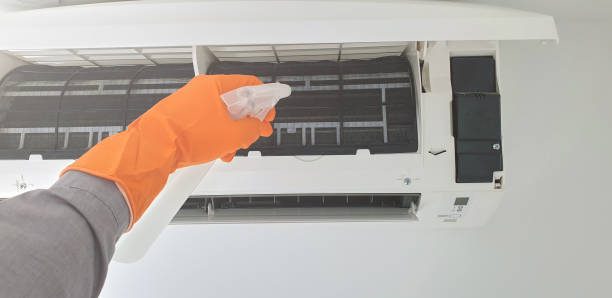
What to do: Open the front cover of the indoor unit, slide out the filters, rinse with water, let them dry completely, slot them back. Takes 5 minutes. In Singapore’s dusty environment, this should be done every 2 to 4 weeks.
CI: Auto Clean Indicator
Also not really a fault. CI means the indoor unit is operating its Auto Clean function, typically to remove odours and dry out the internal coil after cooling. Some models trigger this automatically; others require manual activation through the remote.
Severity: None. The unit is cleaning itself.
What to do: Let the function complete (usually 30 to 60 minutes). If odours persist after Auto Clean, the unit likely has mould or bacterial buildup deeper inside that needs a proper service. See our mouldy aircon guide.
dF: Automatic Defrost Function
Not a fault. dF indicates the outdoor unit is running its automatic defrost cycle, or steam is being produced. This only applies to heat pump models in heating mode. In Singapore where heating mode is rarely used, you shouldn’t see dF often.
Severity: None.
What to do: Nothing required. Switch off Heat mode if you don’t need it; the function will turn off automatically.
E1 or 21: Defective Room Temperature Sensor
The thermistor reading room temperature is shorted or faulty. The aircon may not turn on, or it may run but can’t accurately modulate cooling. Common in units over 5 years old.
Severity: Medium. Aircon may not function properly.
What to do: Call an authorised Samsung service centre or a qualified third-party technician (we service Samsung). Sensor replacement runs $130 to $180 in Singapore.
E1 or 22: Defective Heat Exchanger Temperature Sensor
The thermistor on the indoor heat exchanger coil is shorted or faulty. Important sensor because it’s used for freeze protection logic.
Severity: Medium.
What to do: Sensor replacement. Similar cost to E1 or 21.
E1 or 54: Defective Fan Motor or Capacitor
The indoor fan motor or its capacitor has failed. The unit may run but the fan won’t spin, or the fan will rotate intermittently.
Severity: High. The unit can’t move cooled air without a working fan.
What to do: Switch off. Fan motor replacement runs $200 to $350. Capacitor replacement runs from $130.
E1 or 63: Defective EEPROM
The EEPROM chip storing the unit’s configuration has data corruption. Without the EEPROM functioning, the indoor PCB doesn’t know its capacity setting and operating parameters.
Severity: High. Unit will not operate normally.
What to do: EEPROM replacement or indoor PCB replacement. $130 for EEPROM alone, $250 to $450 if full PCB replacement is needed.
E5: Indoor Heat Exchanger Sensor Short or Open
The thermistor on the indoor heat exchanger has either shorted to ground or has an open circuit. Different from E1 or 22 in that E5 indicates a more specific electrical fault on the sensor itself.
Severity: Medium.
What to do: Check the sensor connector for damage. Sensor replacement if needed. From $130.
E6: Outdoor Heat Exchanger Sensor Short or Open
Same as E5 but on the outdoor heat exchanger coil sensor. Same fix pattern.
Severity: Medium.
What to do: Outdoor sensor replacement. Similar cost.
E7: Heater Temperature Sensor Short or Open
The heater temperature sensor (relevant for models with electric heating function) is faulty. Less common in Singapore where cooling-only operation dominates.
Severity: Medium.
What to do: Sensor replacement.
Extended C-Code Reference
Samsung’s commercial and newer split models use a C-code system (also written as “E1xx” on some displays) covering additional faults beyond the common ones above. Here are the codes we see most often in Singapore Samsung installations:
Communication and Power Codes
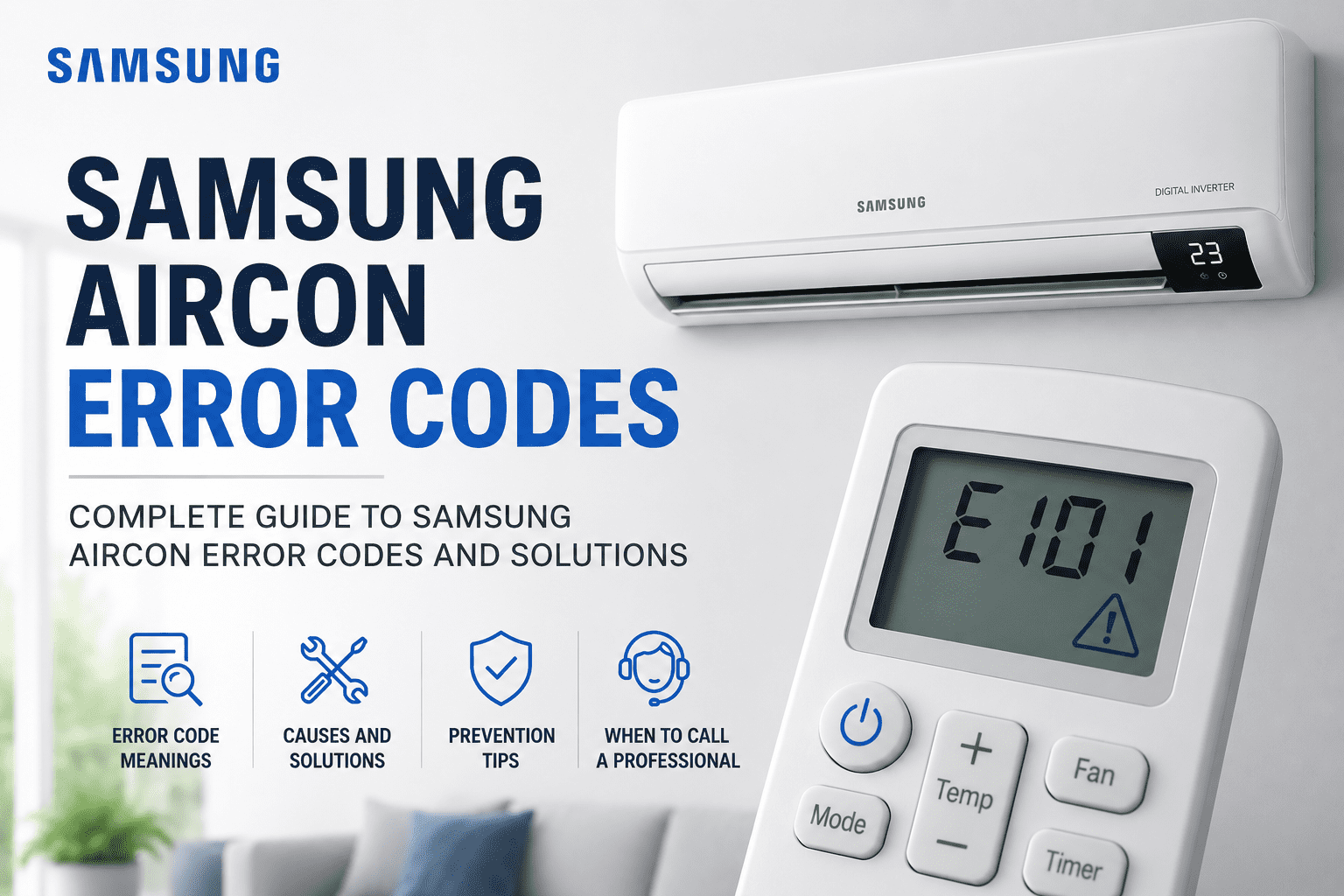
- C-101 / E101: Indoor-outdoor unit communication error. Same pattern as other brands . check outdoor unit power, communication cable, terminal connections.
- C-102 / E102: Communication error between indoor units in a multi-split system. Wiring or addressing issue.
- C-201 / E201: Mismatch between connected indoor and outdoor units. Capacity or model pairing error.
- C-202 / E202: No outdoor unit detected. Often a wiring issue or outdoor unit power off.
- C-203 / E203: Outdoor unit ID conflict in multi-system setup.
- C-204 / E204: Number of indoor units exceeds outdoor unit capacity limit.
Sensor Codes
- C-221 / E221: Indoor temperature sensor short or open (same as E1 or 21).
- C-231 / E231: Indoor heat exchanger sensor (inlet pipe) fault.
- C-251 / E251: Indoor heat exchanger sensor (outlet pipe) fault.
- C-301 / E301: Outdoor temperature sensor fault.
- C-303 / E303: Outdoor pipe temperature sensor fault.
Compressor and Pressure Codes
- C-416 / E416: Compressor discharge temperature too high. Often low refrigerant.
- C-422 / E422: High pressure protection. Usually dirty outdoor unit.
- C-440 / E440: Outdoor compressor blocked or seized.
- C-441 / E441: Refrigerant leakage detected.
- C-458 / E458: Outdoor fan motor error.
- C-461 / E461: Compressor start failure.
- C-462 / E462: Compressor current detection error (CT fault).
- C-463 / E463: Discharge thermistor temperature too high.
- C-464 / E464: Compressor IPM trip (overcurrent).
Inverter and PCB Codes
- C-466 / E466: DC voltage abnormal on inverter PCB.
- C-468 / E468: Current sensor fault.
- C-469 / E469: DC voltage too low.
- C-471 / E471: Outdoor EEPROM error.
- C-472 / E472: AC voltage abnormal.
- C-474 / E474: Outdoor inverter PCB heat sink overheating.
Drainage Codes
- C-554 / E554: Drain water sensor abnormality.
- C-558 / E558: Drain pump fault. Common in cassette and ducted Samsung indoor units in Singapore.
What Each Category Means
C-100 series: Communication Issues
The most common Samsung codes we attend. Almost always traceable to outdoor unit power, communication cable, or PCB issues. First check: is the outdoor isolator on? After that, inspect terminal connections.
C-200 series: System Pairing
Usually appears after installation, repair, or component swap. The system has detected mismatched components. Needs technician verification of the installation specs.
C-220 to C-310 series: Sensors
Standard thermistor faults. Cheap fixes once the specific sensor is identified. Parts under $80, repairs from $130.
C-400 series: Compressor and Refrigerant
Serious. Usually involves refrigerant issues, compressor wear, or inverter electrical faults. Don’t keep running the unit. Diagnosis and pressure testing required.
C-460 to C-470 series: Inverter Drive
Most serious category. Inverter PCB or compressor fault. Replacement costs run $300 to $750+ depending on which component has failed.
C-550 series: Drainage
Drain pump or drain pipe issues. Common in cassette Samsung units in Singapore. Often a drain pipe vacuum during servicing resolves these on the spot. See our water leak guide.
What to Do When You See a Samsung Error Code
- Note the exact code displayed. Photograph the display panel.
- For maintenance codes (CF, CI, dF): follow the routine action (filter clean, let auto-clean run, switch off heat mode).
- For E5, E6, E7: book a service within the next few days. Sensor replacement is straightforward.
- For E1 plus 54 or 63: switch off and call a technician. Fan motor or EEPROM faults can cascade if ignored.
- For C-400 and C-460 series: switch off immediately. Compressor or inverter damage risk.
- For C-100 series (communication): check the outdoor unit isolator first before calling.
- WhatsApp +65 8818 5781 with a photo of the code and your outdoor unit nameplate. We’ll identify the cause before sending a team.
How Much Does Fixing a Samsung Error Code Cost in Singapore?
Lion City Aircon pricing across Singapore (HDB, condo, landed, same rate):
- Filter clean / CF reset: free if you do it yourself, $35 to $50 as part of a service visit
- Diagnostic visit: $35 to $50 per unit
- Thermistor replacement (E1 or 21, 22, E5, E6, E7, C-2xx, C-3xx): from $130 (parts and labour)
- EEPROM replacement (E1 or 63, C-471): from $130
- Capacitor replacement: from $130
- Fan motor replacement (E1 or 54, C-458): $200 to $350
- Drain pump replacement (C-558): $180 to $280
- Indoor PCB replacement: $250 to $450
- Outdoor PCB or inverter PCB replacement (C-466 to C-474): $300 to $600
- Gas leak repair plus recharge (C-416, C-441): from $180
- Compressor replacement (C-440, C-461, C-464): from $750
If you’re on our annual maintenance contract, diagnostic visits are free and most thermistor and capacitor replacements are included between scheduled visits.
Frequently Asked Questions About Samsung Error Codes
What’s the most common Samsung error code in Singapore?
CF (filter reminder) is the most commonly displayed, but it’s not a fault. Among actual faults, C-101 / E101 (communication) is the most common, followed by E5 or E6 (heat exchanger sensors) and C-558 (drain pump). All are diagnosable in a single visit.
Why does my Samsung show CF even after I clean the filter?
The CF indicator doesn’t always clear automatically. On most Samsung models, you need to press the filter reset button on the remote (sometimes a small button labelled “Filter” or accessed by holding the Timer button for 3 seconds). Check your specific model’s manual or send us a photo of your remote and we’ll show you which button.
The display shows “E1” and then “21” alternately. What does that mean?
That’s a single code: E1 or 21. Samsung sometimes alternates between the main code (E1) and the sub-code (21) to give more specific fault information. The combination E1 or 21 means defective room temperature sensor. Look at the table above for the right cause.
Can I clear a Samsung error code by switching off the aircon?
Maintenance codes (CF, CI, dF) clear after the relevant action. Fault codes (E1, E5, E6, E7, C-codes) may temporarily clear with a power reset but will return because the underlying fault is physical. Don’t ignore returning codes.
My Samsung remote doesn’t show any code but the unit isn’t working. What do I do?
Check the indoor unit’s display panel directly. Sometimes the remote doesn’t sync with the unit’s stored error log. If neither the remote nor the display shows a code, check the LED on the unit (most Samsung models have an indicator that blinks slowly for sensor faults or rapidly for serious electrical faults). Send us a video.
Should I try to fix Samsung codes myself?
Filter cleaning (CF), drain pipe checks, basic power resets, and visual inspection are safe. Anything involving sensors, refrigerant, compressor, or PCB needs a licensed technician. Refrigerant handling is regulated in Singapore.
Why does Samsung use both E-codes and C-codes?
Older Samsung models used the E1, E5, E6, E7 system. Newer models (and most commercial systems) use the more granular C-code system (C-101 onwards). Some display panels show both: the simple code first (E1), then a sub-code (54), which together correspond to a specific C-code (C-458 in this case). The system is essentially the same underneath.
Are Samsung codes the same on all models in Singapore?
Mostly. The core E-codes (E1 with sub-codes, E5, E6, E7) and the C-100 to C-558 range are consistent across Samsung residential splits and multi-systems sold in Singapore. Some commercial DVM systems have additional codes specific to their architecture.
How long does fixing a Samsung error code take?
Most diagnoses take 30 to 45 minutes. Sensor or EEPROM replacements add 30 minutes. PCB or motor replacements take 60 to 90 minutes. Compressor replacement takes 2 to 3 hours. We carry common Samsung parts on the truck, so most fixes are complete in a single visit.
Get Your Samsung Aircon Fixed Today
Most Samsung error codes are diagnosable in a single visit. The longer you wait with an active fault, the more likely cascading damage develops, especially with C-400 and C-460 series codes affecting the compressor or inverter.
WhatsApp +65 8818 5781 with a photo of the error code and your outdoor unit nameplate. We diagnose remotely where possible and dispatch a team. Same-day service in most cases across Singapore. 22,000+ jobs done since 2016, 5.0★ across 1,500+ Google reviews, BizSafe Level 3 certified.
No scare tactics. No upselling. If your fix is a $130 sensor, we’ll tell you that and price it accordingly. If it’s a serious inverter or compressor issue, we’ll show you what we found and give you honest repair-versus-replace numbers before doing anything.
WhatsApp Lion City Aircon · Call +65 8818 5781 · Book online
Related reading: Daikin error codes · Toshiba error codes · Panasonic error codes · Hitachi fault codes · Mitsubishi error codes · LG error codes