If you’re using your aircon daily, you’ve probably wondered how often to service aircon Singapore homes really need. The high humidity, dusty environment and round the clock cooling we depend on here put far more strain on aircon units than in temperate countries. Skip servicing for too long and you’re heading toward weak cooling, higher electricity bills, water leaks, or worse. A full system breakdown right when you need it most. How often you book a professional aircon servicing in Singapore is the single biggest factor in whether these problems start at all. A service covers the fan coil unit indoors and the condenser outside, the two halves of the system.
This guide answers the most common question we get every day from Singapore homeowners. Plus what happens if you don’t service regularly, how Singapore’s climate changes the rules, and what proper servicing actually looks like.
How Often to Service Aircon Singapore: Frequency by Usage
The short answer: every 3 months, quarterly, for every aircon in Singapore. Even units used lightly. Here’s why we don’t stretch the interval longer, even for occasional users:
One of the main reasons we service an aircon isn’t even about cooling performance. It’s about clearing the drainage pipe. Singapore’s humidity means condensation builds up constantly inside the unit. That water needs a clear path out through the drain pipe. Dust, mould and slime build up in there over time, and once that pipe gets blocked, water has nowhere to go but out the front of your fan coil and down your wall. Quarterly vacuuming of the drain pipe is the single best way to avoid water leakage. Skip it and you’re rolling the dice every month.
| Usage Pattern | Recommended Frequency |
|---|---|
| Light usage (bedroom only, occasional use) | Every 3 months |
| Moderate usage (daily use, a few hours per day) | Every 3 months |
| Heavy usage (whole house, long hours, 12+ hrs/day) | Every 2 to 3 months |
| Commercial / F&B (operating hours 8+ hrs/day) | Every 1 to 2 months |
You’ll see other companies recommend 6 month or annual servicing intervals. That advice comes from dry, temperate climates, not Singapore. Our 80%+ year round humidity, construction dust and 24/7 cooling habits put aircons under conditions you won’t find in Europe or America. Quarterly is the Singapore standard, and that’s what we recommend across the board.
Signs Your Aircon Needs Servicing. Don’t Wait.
Even if your servicing is “due” by the calendar, these warning signs mean you should book sooner:
- Weak cooling performance. Dirt buildup on coils and filters is reducing airflow.
- Unusual noises. Rattling, buzzing, or whirring sounds mean parts need cleaning or fixing.
- Musty or bad smells when the aircon turns on. Mould or bacteria buildup inside the fan coil.
- Water leaking from the indoor unit. Usually a clogged drainage pipe.
- Higher electricity bills without changing your usage habits.
- Visible dirt on the fins or front grill.
These are early warning signs of bigger issues. Catch them now, fix them cheaply. Wait, and you’re looking at a chemical wash, gas top-up, or compressor replacement.
What Happens During Aircon Servicing?
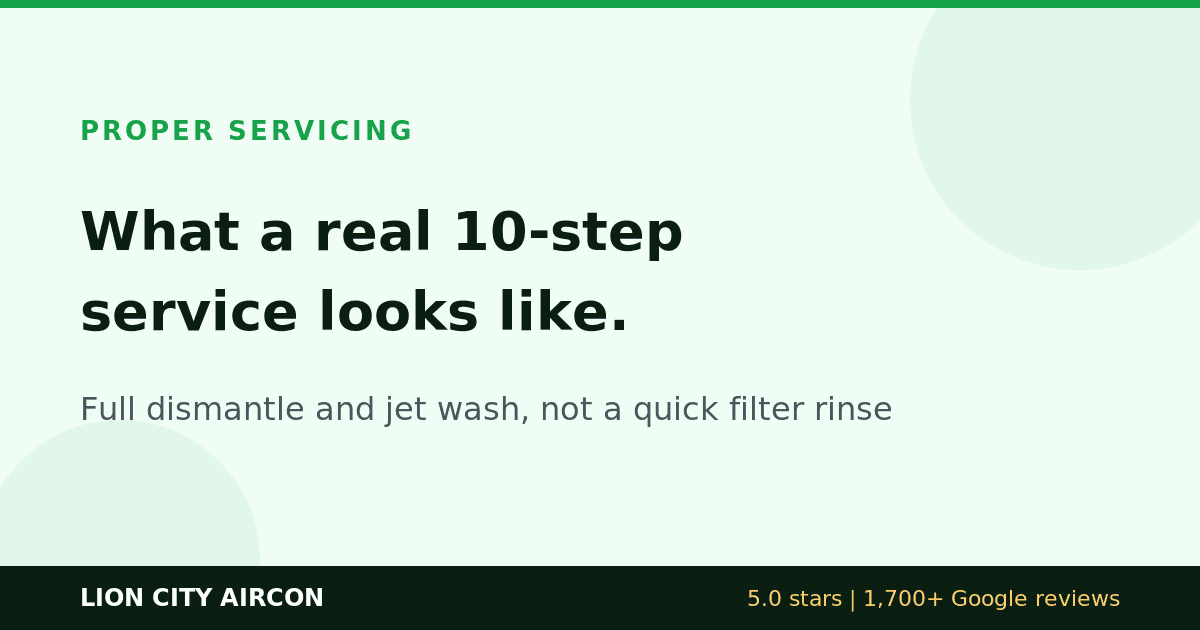
A proper general servicing covers:
- Full dismantle of the fan coil cover, swing flap and filter housing
- Removal and cleaning of the water tray and blower wheel
- Jet wash of all dismantled parts (this is what separates real servicing from a 10 minute filter vacuum)
- Vacuuming the drainage pipe
- Checking gas pressure with proper gauges
- Inspecting electrical components and condenser unit
- Reassembly and full cooling test before we leave
Anything less than this isn’t really servicing. It’s a quick clean. See our full 10 step aircon servicing process for what you should expect from any reputable company.
What Happens If You Don’t Service Your Aircon Regularly?
Skipping servicing has real consequences, and most of them are expensive:
1. Decreased efficiency and higher bills
Over time, air filters clog with dust and debris, making it harder for the system to cool effectively. The unit works harder, consuming more electricity. In Singapore where aircon can be 60 to 70% of your electricity bill in some months, that’s not a small deal.
2. Health risks from poor air quality
Air conditioners filter pollutants and allergens. But if they’re not serviced, those filters become breeding grounds for mould, bacteria and other microorganisms. This circulates back into the air you breathe and can cause respiratory issues, especially for kids and elderly family members.
3. Mechanical failures and breakdowns
Neglected units are more prone to compressor failure, motor burnout, PCB issues and gas leaks. Regular servicing catches these problems early, when they’re cheap to fix. Wait until something fails completely and you’re looking at hundreds or thousands of dollars in repairs.
4. Voided manufacturer warranty
Most aircon manufacturer warranties require proof of regular servicing. If you’ve never serviced the unit and the compressor fails in year 3, the manufacturer can reject the warranty claim, leaving you to foot the bill.
5. Shortened lifespan
A well maintained aircon lasts 12 to 15 years. A neglected one might give up in 6 to 8. Servicing isn’t an expense. It’s an investment in not having to spend $2,180+ on a new installation.
Why Singapore’s Climate Changes the Rules
Singapore’s combination of year round 30°C heat and 80%+ humidity makes our aircons work harder than almost anywhere else in the world. Add in:
- Dust from construction. Singapore is constantly building, and that dust gets into your fan coils.
- HDB density. Outdoor units share airflow with neighbours’ condensers.
- Coastal salt air. Corrodes outdoor unit components faster.
- 24/7 cooling habits. Most homes here run aircon nightly, year round.
This is why a “service yearly” rule from European or American advice doesn’t apply here. Quarterly is the Singapore baseline.
Beyond Regular Servicing: When You’ll Need More
Even with quarterly general servicing, some homes need extra interventions over time:
- Chemical wash. Recommended once every 12 months when general servicing isn’t getting your unit clean enough. See chemical wash pricing.
- Chemical overhaul. Full disassembly and deep clean, usually every 2 to 3 years for heavy use units. See chemical overhaul details.
- Gas top-up. If cooling has weakened despite servicing, refrigerant may be low. See gas top-up info.
- Component replacements. Capacitors, fan motors and compressors wear out. Proactive replacement prevents breakdowns.
Annual Maintenance Contract: The Predictable Option
If you’ve got multiple units and want predictable upkeep, our Annual Maintenance Contract covers all four quarterly visits in one straightforward agreement. Here’s exactly what’s included:
- 4 quarterly servicing visits across the 12 month period
- One free gas top-up per compressor if needed during the contract
- Free troubleshooting visits while the contract is valid
- Free water leak repair while the contract is valid
- Priority same day booking for contract customers
- Dismantling of cover, water tray and blower for thorough cleaning (where unit design permits)
- Filter, evaporator coil and condenser coil cleaning
- Inspection of refrigerant levels, electrical connections, drain pipes and control systems
- Defect reporting. We tell you what needs attention, no upselling pressure.
What’s not included: Spare parts and labour for component replacements (compressors, PCBs, motors, capacitors) are billed separately. But only with your approval first. No surprise charges.
Pricing starts from $174.40/year for 1 unit. See full contract pricing on our servicing page or WhatsApp us +65 8818 5781 for a quote.
Book Your Aircon Servicing Today
At Lion City Aircon, we’ve serviced 25,000+ jobs since 2016 across all of Singapore. HDB, condo, landed and small commercial. 5.0★ Google rating with 2,300+ verified reviews.
- Call or WhatsApp: +65 8818 5781
- Book Online: Booking page
- Email: contact@lioncityaircon.sg
Frequently Asked Questions
How often should I service my aircon in Singapore?
Every 3 months (quarterly) is the Singapore standard, regardless of how lightly you use it. The main reason isn’t just cooling performance, it’s clearing the drainage pipe before condensation buildup causes water leakage. Heavy 24/7 usage needs every 2 to 3 months. Commercial / F&B premises need every 1 to 2 months.
Is aircon servicing really necessary?
Yes. Skipping servicing leads to weak cooling, higher electricity bills, mould related health issues, system breakdowns, and a shorter unit lifespan. It also typically voids your manufacturer warranty.
Can I clean my aircon myself?
Basic filter washing every month or two is fine. But professional servicing covers internal components you can’t reach. The fan coil base, the blower wheel, the drainage pipe, gas pressure checks. These need proper tools and training.
What’s the difference between servicing and chemical wash?
General servicing is the routine clean (every 3 months). Chemical wash uses cleaning agents to break down deeper grime and mould inside the fan coil. Usually needed once every 12 months. See our chemical wash page for full details.
How long does aircon servicing take?
About 20 to 30 minutes per unit for a general service. A typical HDB with 3 fan coils takes about an hour. Chemical wash takes longer, about 45 minutes per unit.
Do I need to be home during the servicing?
Yes. Someone needs to let us in and be there during the work. We’ll cover the floor to protect from water spillage, but having you around means you can ask questions and we can show you anything that needs attention.
Related Reading
- Aircon not cooling? Aircon Not Cooling: Causes & Fixes
- Aircon leaking water? Why Is My Aircon Dripping Water?
- Looking for full pricing? Aircon Servicing Singapore. Complete Pricing.
- Need a chemical wash? Aircon Chemical Wash Singapore
Related reading: Chemical wash vs general servicing · Servicing price guide
Our aircon repair in Singapore team deals with this every week, and our rates are published openly.